We file VAT returns and corporate tax returns for clients every week. The returns are only as accurate as the data that feeds them. That data comes from accounting software. When the software is set up correctly, the VAT return generates cleanly, the P&L maps to the CT return, and the FTA audit file exports without errors. When the software is set up wrong, every return is a manual correction exercise, every quarter is a reconciliation nightmare, and the first FTA audit exposes problems that should have been caught at configuration.
This is not a software review. Software reviews compare feature lists and pricing tiers. This is a practitioner's assessment of how Zoho Books, QuickBooks Online, and Xero perform in the one context that matters to UAE business owners: producing accurate, FTA-compliant financial data for VAT and CT filing. We use all three platforms across our client base. We know which features work in practice, which features sound good in demos but fail in production, and which configuration mistakes cause the most expensive problems.
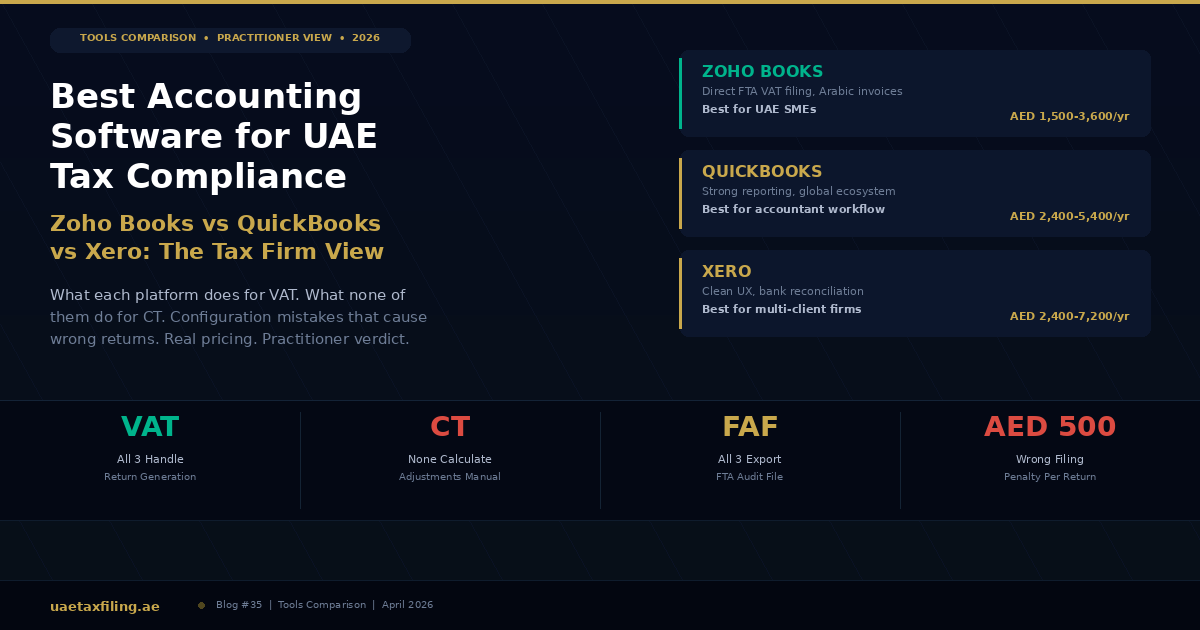
The short answer: all three platforms can handle UAE VAT compliance if configured correctly. None of them calculate your corporate tax liability. The difference is not in capability but in how much effort each platform requires to get from raw transaction data to a filed return. As EAS MEA's tools review documented, accounting software provides the inputs for your CT calculation, not the final calculation itself. A tax professional is still needed to make CT adjustments. That gap between what the software produces and what the FTA requires on the CT return is where most filing errors originate.
"We onboard clients from all three platforms. The platform matters less than the configuration. A correctly configured Zoho Books installation produces better data than a badly configured QuickBooks installation, and vice versa. When we take over a client whose accountant set up the software without understanding UAE tax codes, the first three months are spent fixing the chart of accounts, not filing returns. The software is a tool. The configuration is the craft."
Jazim, CEO, UAE Tax Filing LLC
What All Three Platforms Do Well for UAE Tax
Before comparing the differences, it is worth establishing what every modern cloud accounting platform handles competently for UAE businesses. As OneDeskSolution's 2026 selection checklist documents, the baseline requirements for UAE tax compliance are now well understood, and all three major platforms meet them.
VAT-compliant invoicing. All three generate tax invoices that meet FTA requirements under Article 65 of the VAT Executive Regulation: supplier name and TRN, buyer name and TRN, sequential invoice number, date, line item descriptions, VAT rate and amount, and total including VAT. Zoho Books, QuickBooks, and Xero all produce compliant invoices out of the box once the TRN is configured. For the upcoming e-invoicing mandate, all three are expected to integrate with Accredited Service Providers (ASPs) by 2027, though the timing of each vendor's PINT AE module release varies.
5% VAT calculation and tracking. Standard-rated supplies (5%), zero-rated supplies (0%), and exempt supplies are all configurable in each platform. The software applies the correct rate to each line item, calculates VAT on invoices and bills, and maintains the running VAT liability (output VAT collected minus input VAT paid). This is the core function that determines the accuracy of your quarterly VAT return.
FTA Audit File (FAF) generation. The FTA can request a FAF during a VAT audit, a standardized CSV export of your general ledger. All three platforms generate this file, though the export format sometimes needs minor formatting adjustments to match the FTA's exact CSV specification. As ReconcileOS's guide noted, generating a valid FAF from a manual system is technically difficult and often results in formatting errors that trigger further scrutiny. Cloud platforms eliminate this problem.
Multi-currency handling. Dubai is a trading hub. Most businesses transact in AED, USD, EUR, and GBP at minimum. All three platforms support multi-currency invoicing, automatic or manual exchange rate application, and foreign currency gain/loss tracking. For e-commerce sellers receiving settlements in multiple currencies from Amazon or Noon, multi-currency support is essential for accurate revenue recording.
Bank feed integration. All three connect to major UAE banks (Emirates NBD, ADCB, Mashreq, FAB, RAK Bank) for automatic transaction import. This is the foundation of efficient reconciliation: bank transactions flow into the platform, you match them to invoices and bills, and the ledger stays current without manual data entry.
Zoho Books: The UAE Market Leader for SMEs
Best for: Startups, freelancers, sole traders, and SMEs with revenue under AED 10 million. Businesses already using other Zoho products (CRM, Payroll, Inventory). Businesses that want to file VAT returns directly from the platform without leaving the software.
The UAE advantage. Zoho Books is the only major platform that offers direct VAT return filing to the FTA from within the software. You generate the VAT 201 report, review it, and submit it directly to EmaraTax without logging into the FTA portal separately. This saves approximately 30-45 minutes per quarterly filing and eliminates the transcription errors that occur when manually re-entering figures from an accounting report into the FTA portal. As Zoho's UAE corporate tax page confirms, the platform also includes a dedicated CT module that maps your chart of accounts to the CT return fields, though the final CT adjustments (non-deductible items, the AED 375,000 band, SBR election) still require professional review.
Arabic and bilingual invoicing. Zoho natively supports Arabic-English bilingual invoices, which is a requirement for certain government contracts and some B2B transactions. QuickBooks and Xero can produce Arabic invoices through customization, but Zoho handles it as a standard feature without workarounds.
Pricing (2026). The Free plan supports basic bookkeeping for very small businesses (limited to 1,000 invoices/year). The Standard plan at approximately AED 110/month (AED 1,320/year) covers most SME needs. The Professional plan at approximately AED 220/month (AED 2,640/year) adds purchase orders, inventory, and project accounting. The Premium plan at approximately AED 300/month (AED 3,600/year) adds advanced inventory, custom modules, and higher transaction limits. These are the most competitive prices among the three major platforms.
Where Zoho falls short. The learning curve is steeper than it appears. Zoho offers more configuration options than QuickBooks or Xero, which means more things can go wrong during setup. Support quality is inconsistent: some queries get resolved quickly, others bounce between support tiers. For businesses with complex multi-entity structures (mainland LLC plus free zone FZE plus holding company), Zoho's inter-company transaction handling is functional but not as polished as QuickBooks or Xero. For high-volume transaction matching (e-commerce sellers processing thousands of settlement lines per month), Zoho's native reconciliation is adequate but may need supplementary tools.
QuickBooks Online: The Accountant's Preferred Platform
Best for: Established SMEs with existing accountant relationships, businesses with complex reporting requirements, and companies that need deep third-party integrations (payroll, POS, inventory management, CRM).
The reporting advantage. QuickBooks produces the most detailed financial reports of the three platforms. The P&L, balance sheet, trial balance, and general ledger reports export cleanly and map well to the IFRS financial statement structure that the CT return requires. For businesses that need audited financial statements (QFZPs, larger mainland entities), QuickBooks provides the cleanest starting data for the auditor. As CrossVal's 2026 comparison noted, QuickBooks is the platform of choice when you have an accountant or bookkeeper who needs reliable, globally recognized reporting tools.
The global ecosystem. QuickBooks has the largest third-party app marketplace of any accounting platform. Payroll integrations (WPS-compliant for UAE), POS systems, inventory management tools, time-tracking apps, and expense management platforms all connect to QuickBooks. For businesses using multiple software tools, QuickBooks acts as the central financial hub that aggregates data from various sources.
Pricing (2026). The Simple Start plan at approximately AED 200/month (AED 2,400/year) covers invoicing, expenses, and basic reporting. The Essentials plan at approximately AED 300/month (AED 3,600/year) adds bill management and multi-user access. The Plus plan at approximately AED 450/month (AED 5,400/year) adds inventory tracking, project profitability, and budgeting. QuickBooks is more expensive than Zoho at every tier but offers deeper reporting and integration capabilities.
Where QuickBooks falls short. No direct VAT filing to FTA from the platform. You generate the VAT report, then log into EmaraTax and enter the figures manually. This creates transcription risk. The UAE-specific localization is good but not native: QuickBooks is a global platform adapted for the UAE, while Zoho was built with UAE compliance as a core market. Arabic invoice support requires template customization rather than being a standard setting. For very small businesses (under AED 500,000 revenue), QuickBooks is over-specified and over-priced relative to what you actually need.
Choosing the right platform is the first decision. Configuring it for UAE tax compliance is the second. Our accounting team sets up Zoho Books, QuickBooks, or Xero for new clients with UAE-specific chart of accounts, proper VAT tax codes, and CT-ready reporting from day one. Message us on WhatsApp.
Xero: The Multi-Client Platform for Accounting Firms
Best for: Businesses that work closely with an external accountant or bookkeeping firm, companies that value clean user experience, and businesses with international operations that need strong multi-currency bank reconciliation.
The UX advantage. Xero has the cleanest, most intuitive interface of the three platforms. The dashboard is uncluttered, the navigation is logical, and the bank reconciliation workflow is the fastest among the three. For business owners who do some of their own bookkeeping (entering invoices, reconciling bank transactions, approving expenses), Xero requires the least training time. The platform is designed for non-accountants to use daily with minimal friction.
The accountant collaboration model. Xero's multi-client management is the strongest of the three platforms. Accounting firms managing 50+ clients can switch between client books instantly, apply standardized templates, and maintain consistent workflows across all clients. This is why Xero is the most popular platform among UAE accounting firms, even though Zoho is the most popular among business owners directly.
Pricing (2026). The Starter plan at approximately AED 200/month (AED 2,400/year) supports limited invoicing and bank reconciliation. The Standard plan at approximately AED 350/month (AED 4,200/year) covers unlimited invoicing, bills, and multi-currency. The Premium plan at approximately AED 600/month (AED 7,200/year) adds multi-currency, expense management, and projects. Xero is the most expensive option, particularly at the Premium tier where the price differential with Zoho is significant.
Where Xero falls short. No direct VAT filing to FTA (same limitation as QuickBooks). The third-party app ecosystem, while good globally, has fewer UAE-specific integrations than QuickBooks. Inventory management is weaker than both Zoho and QuickBooks, making it unsuitable for trading companies or e-commerce sellers with significant stock. Arabic invoice support requires manual template work. For businesses that need their accounting platform to also handle inventory, project costing, and payroll, Xero requires more add-on apps (and their costs) than Zoho or QuickBooks.
What None of Them Do: The Corporate Tax Gap
This is the section that every software vendor avoids and every business owner needs to understand. All three platforms handle VAT well. None of them calculate your corporate tax liability. The CT return requires manual adjustments that no accounting software performs automatically.
Non-deductible expense adjustments. Your P&L shows total entertainment expenses of AED 80,000. The CT law allows only 50% deduction. The remaining AED 40,000 must be added back to taxable income. Your P&L shows a AED 5,000 traffic fine paid during the year. Fines are non-deductible and must be added back. Your P&L shows AED 12,000 in personal expenses run through the business. Non-deductible, added back. Our deductions guide covers every category. No accounting platform performs these add-backs automatically. A tax professional reviews the P&L and identifies which expenses must be adjusted on the CT return.
The AED 375,000 zero-rate band. This is a CT calculation step, not an accounting entry. The software produces net profit. The CT return applies the AED 375,000 band to determine taxable income above the threshold. This calculation happens on the EmaraTax CT return form, not in the accounting software.
Small Business Relief election. The SBR decision is made on the CT return, not in the accounting software. The platform does not know whether you should elect SBR. It does not evaluate the loss carry-forward trade-off that makes SBR destructive in loss years. A tax advisor makes this decision based on multi-year financial projections, not on data the software can provide.
Loss carry-forward tracking. If your business had a loss in a prior year, that loss offsets current-year profits on the CT return. Our loss carry-forward guide covers the 75% cap and the ownership continuity test. No accounting platform maintains a carried-forward loss schedule that maps to the CT return requirements. This is tracked manually by the tax advisor or in a separate working paper.
Related party disclosure (Schedule 5). Businesses with related party transactions must disclose them on Schedule 5 of the CT return. The accounting software records these transactions like any other, but it does not flag them as related party or prepare the disclosure schedule. Identification and documentation of related party transactions is a professional judgment that the software cannot make.
The bottom line: Your accounting software produces the raw P&L. Your tax advisor takes that P&L and builds the CT return by applying adjustments, elections, reliefs, and disclosures that the software does not handle. As our how much does CT cost article showed, the effective rate for most SMEs is 0% to 4% of revenue. Getting from the P&L to that number requires professional work that sits outside the software. If your accountant tells you the software 'does your corporate tax,' ask them exactly which adjustments the software makes. The answer is none.
Which Platform for Which Business: The Decision Framework
Solo freelancer or consultant (under AED 1M revenue): Zoho Books Standard. Lowest cost, direct VAT filing, simple setup. You do not need QuickBooks' advanced reporting or Xero's multi-client features. If your revenue is below AED 375,000 (VAT threshold), you may not even need accounting software beyond a simple spreadsheet, but Zoho's free tier covers basic needs if you want to formalize your books for future CT registration.
SME with 5-20 employees (AED 1M-10M revenue): Zoho Books Professional or QuickBooks Essentials. At this scale, you need proper expense tracking, bill management, multi-user access, and reliable reporting for your quarterly VAT returns and annual CT filing. If you already have an accountant using QuickBooks, stay on QuickBooks. If you are choosing fresh, Zoho offers more UAE-specific features at a lower price.
E-commerce seller (Amazon/Noon): Zoho Books or QuickBooks with a reconciliation add-on. The platform needs to handle multi-channel revenue, marketplace settlement reconciliation, and inventory valuation. As ReconcileOS documented, standard accounting software operates on 1-to-1 match logic, but marketplace settlements are 1-to-many (one deposit covers dozens of orders minus fees). A reconciliation layer is essential for accuracy. Our e-commerce CT guide covers the specific reconciliation requirements.
Multi-entity group (mainland + free zone): QuickBooks Plus or Xero Premium, with inter-company transaction tracking. You need consolidated reporting, entity-level P&L separation, and the ability to track transactions between related entities for transfer pricing disclosure. Zoho can handle this but requires more manual configuration than QuickBooks or Xero at the multi-entity level.
Working with an external accounting firm: Xero or QuickBooks. Both platforms support smooth accountant access, role-based permissions, and the multi-client management that your outsourced accounting provider needs. If your accountant has a preference, use their preferred platform. The efficiency gain from your accountant working on a familiar system exceeds any feature difference between platforms.
We work across all three platforms and can advise on the best fit for your specific situation. Whether you are setting up for the first time or migrating from spreadsheets or a legacy system, our team handles the configuration, chart of accounts setup, and UAE tax code mapping. Talk to us on WhatsApp.
Five Configuration Mistakes That Cause Wrong Returns
1. Wrong VAT tax codes on revenue categories. Every revenue line must be tagged with the correct VAT treatment: standard-rated (5%), zero-rated (0%), or exempt. If a zero-rated export sale is tagged as standard-rated, you over-charge VAT to the customer and over-report output VAT on the VAT return. If a standard-rated domestic sale is tagged as exempt, you under-report. The tax code configuration is set once during setup and applied automatically to every transaction. Get it wrong at setup, and every invoice for the next year carries the error.
2. Not separating non-deductible expenses in the chart of accounts. If your chart of accounts has a single 'General Expenses' category that mixes deductible expenses (office supplies) with non-deductible expenses (fines, personal costs, the non-deductible 50% of entertainment), the tax advisor cannot efficiently identify the add-back items at CT filing time. The fix: create separate accounts for entertainment (so the 50% cap can be applied), fines and penalties (always non-deductible), and personal expenses (always non-deductible). This takes 15 minutes at setup and saves hours at tax time.
3. Recording net marketplace deposits as revenue. This is the gross vs net trap that catches every e-commerce seller. The platform must be configured to record gross revenue (what the customer paid) as income, with marketplace fees as separate expense entries. If you configure it to record the bank deposit (net of fees) as revenue, your accounting revenue will not match your VAT return revenue, triggering the automated audit flag.
4. Not configuring multi-currency correctly. A business that invoices in USD but reports in AED must configure the exchange rate source and frequency. If the platform uses a daily rate but your invoices use a monthly average, the VAT return figures will not match the P&L figures because the exchange rates applied at invoice level differ from those applied at reporting level. Choose one rate method and apply it consistently.
5. Skipping bank reconciliation for months. The software imports bank transactions automatically, but someone still needs to match them to invoices, bills, and expenses. Leaving three months of unreconciled transactions means the VAT return is based on incomplete data. The FTA expects the VAT return to reflect all transactions in the quarter. Unreconciled items may represent unrecorded revenue (understating output VAT) or unrecorded expenses (missing input VAT credits). Monthly reconciliation is the minimum. Weekly is better.
E-Invoicing Readiness: Which Platforms Are Preparing for 2027
The UAE e-invoicing mandate requires all B2B and B2G invoices to be transmitted in structured XML format through an Accredited Service Provider (ASP) by July 2027 for most businesses. This will affect every accounting platform because the invoices your software generates must either be in PINT AE format natively or be converted by the ASP before transmission.
Zoho Books is expected to release a PINT AE module in 2026, leveraging its existing direct FTA integration. QuickBooks and Xero are expected to integrate with ASPs through their third-party app marketplaces, meaning you will likely install an ASP connector app rather than having native e-invoicing built in. The exact timelines are not yet confirmed by any vendor, but businesses should ask their software provider for a specific e-invoicing roadmap before the March 31, 2027 ASP appointment deadline.
The Real Cost Comparison: Software Plus Professional Fees
The software subscription is only part of the annual cost. The total cost of tax-compliant accounting includes the software, the professional who configures and maintains it, and the tax advisor who files the returns. Our outsourced accounting cost guide covers the full spectrum, but here is a summary by business size.
Freelancer / sole trader (under AED 1M): Zoho Books Standard AED 1,320/year + basic bookkeeping AED 3,000-6,000/year + CT filing AED 2,000-4,000/year = Total AED 6,320-11,320/year.
SME with 5-15 staff (AED 1M-5M): Zoho Professional or QuickBooks Essentials AED 2,640-3,600/year + monthly bookkeeping AED 12,000-24,000/year + VAT filing AED 4,000-8,000/year + CT filing AED 5,000-15,000/year = Total AED 23,640-50,600/year.
Multi-entity group (AED 5M+): QuickBooks Plus or Xero Premium AED 5,400-7,200/year + accounting AED 36,000-72,000/year + VAT AED 8,000-16,000/year + CT AED 15,000-40,000/year + audit AED 15,000-40,000/year = Total AED 79,400-175,200/year.
The software cost is 5-15% of the total annual compliance cost. The majority is professional fees. Choosing the cheapest software to save AED 1,500/year while using a poorly configured system that causes AED 10,000 in penalty exposure is false economy. Choose the platform your accountant works best with, configure it correctly once, and the returns take care of themselves.
Frequently Asked Questions
Does the FTA certify or approve specific accounting software?
No. There is no FTA certification for accounting software. 'FTA accredited' is a marketing term used by some vendors. The FTA requires accurate returns and records, regardless of which software you use.
Can accounting software calculate my corporate tax automatically?
No. Accounting software produces the P&L that feeds the CT calculation. The CT adjustments (non-deductible expense add-backs, the AED 375,000 band, SBR election, loss carry-forward) require professional judgment outside the software.
Which platform is best for UAE VAT compliance?
Zoho Books offers the most UAE-specific features, including direct VAT filing to EmaraTax and native Arabic invoicing. QuickBooks and Xero both handle VAT calculations correctly but require manual filing through the FTA portal.
Can I use Excel or Google Sheets instead of accounting software?
Technically, yes. Practically, no. Spreadsheets cannot generate FTA Audit Files, do not automatically track VAT liability, and are prone to formula errors. For any business above AED 375,000 revenue, cloud accounting software is a necessary infrastructure investment.
How much does accounting software cost for a UAE SME?
AED 1,320 to AED 7,200 per year depending on the platform and plan tier. Zoho Books is the most affordable. Xero Premium is the most expensive. The software cost is typically 5-15% of the total annual compliance cost including professional fees.
Should I choose the platform my accountant prefers?
Yes. Your accountant's efficiency on a familiar platform saves more money annually than any feature difference between platforms. If your accountant uses QuickBooks for all their clients, use QuickBooks.
Is Zoho Books better than QuickBooks for UAE businesses?
For SMEs and startups, Zoho offers better UAE-specific value: lower pricing, direct VAT filing, native Arabic support. For businesses with complex reporting needs or established accountant workflows, QuickBooks offers deeper reporting and a larger integration ecosystem.
Can I switch platforms mid-year?
Yes, but migration should happen at a period boundary (start of a quarter or financial year) to avoid data gaps. Expect 1-3 weeks for a clean migration including historical data import, chart of accounts mapping, and opening balance setup.
How do I set up UAE VAT tax codes correctly?
Configure three tax codes: Standard Rate (5%), Zero Rate (0%), and Exempt. Apply them to every revenue and expense category in your chart of accounts. Test by generating a sample VAT return and verifying the output VAT and input VAT figures match your manual expectations.
Will my software be ready for UAE e-invoicing in 2027?
Ask your vendor directly. Zoho is expected to integrate natively. QuickBooks and Xero will likely integrate through ASP connector apps. No vendor has confirmed a specific release date for PINT AE compliance as of April 2026.
The Software Is the Tool. The Configuration Is the Craft.
Zoho Books, QuickBooks, and Xero are all capable platforms for UAE tax compliance. The differences matter at the margins: Zoho for cost and UAE-specific features, QuickBooks for reporting depth and integrations, Xero for user experience and accountant collaboration. None of them calculate corporate tax. All of them produce the financial data that makes CT filing possible.
The choice is less important than the configuration. A correctly set up chart of accounts with proper VAT tax codes, separated expense categories for non-deductible items, and monthly bank reconciliation will produce clean data on any of the three platforms. A poorly configured system will produce wrong returns on all of them.
Choose the platform that fits your business size and your accountant's workflow. Configure it once, correctly, with UAE tax compliance in mind. Then let the software do what it does well (transaction recording, VAT tracking, report generation) and let your tax advisor do what the software cannot (CT adjustments, SBR decisions, loss carry-forward planning, related party disclosures). That division of labor is what produces accurate returns with minimum effort and minimum risk.
We set up, configure, and maintain all three platforms for our clients. Whether you are starting from zero or fixing a broken configuration, our team gets your books UAE-compliant and your returns filing-ready. Start on WhatsApp.